Uncover Luxury Travel With Indian Pacific Train Cabins In 2026 – Complete Pricing And Experience Guide
Few rail journeys in Australia feel as cinematic as the Indian Pacific, a transcontinental ride that runs from Sydney to Perth through mountain passes, red-earth outback, vineyard country, and the long sweep of the Nullarbor. For 2026 travellers, the cabin you choose will shape nearly every part of the trip, from privacy and sleep to meals, lounge access, and overall value. This guide breaks down the cabin options, likely pricing, and the real experience on board so you can book with clearer expectations.
Article outline:
- The route, duration, and why cabins are central to the experience
- A detailed comparison of Gold Single, Gold Twin, and Platinum cabins
- Indicative 2026 pricing, inclusions, and value trade-offs
- Daily life on board, dining, lounge access, and off-train touring
- Booking strategies and the best cabin choice for different traveller types
The Indian Pacific in 2026: Route, Rhythm, and Why the Cabin Matters So Much
The Indian Pacific remains one of the most distinctive rail journeys in the Southern Hemisphere because it is not simply a scenic train trip; it is a continent-crossing experience. The full route links Sydney on Australia’s east coast with Perth on the west coast, covering roughly 4,352 kilometres over about four days and three nights, depending on the direction of travel and the current timetable. Along the way, the landscape changes dramatically. The Blue Mountains give way to the inland plains, South Australia adds a softer agricultural stretch, and then the route pushes across the Nullarbor, where the scale of the country becomes impossible to ignore. Few forms of travel let you watch that transformation unfold from the same seat, the same window, and eventually, the same sleeping berth.
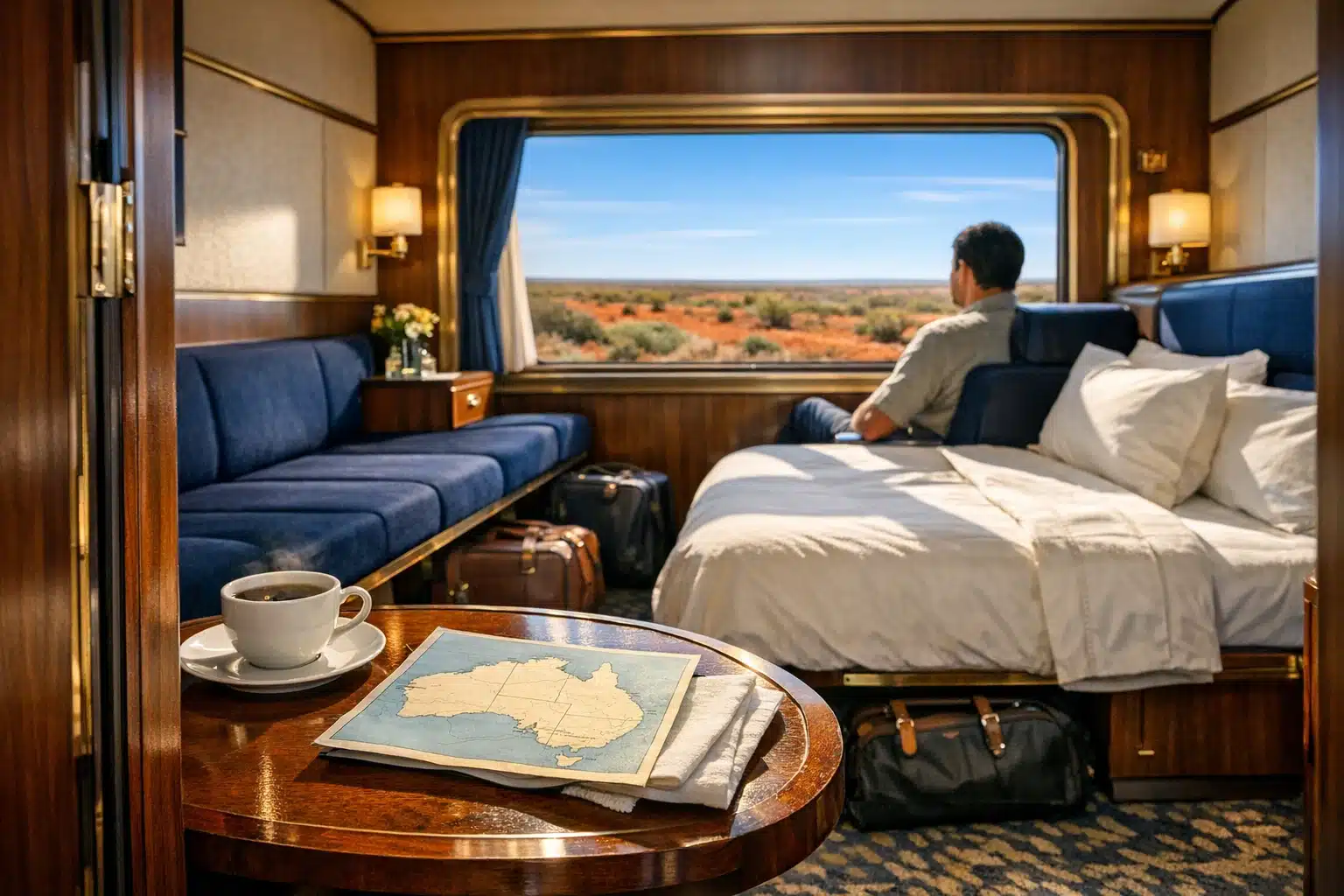
For 2026 travellers, cabin choice matters because the Indian Pacific operates as an accommodation-led rail holiday rather than a basic transport service. Your cabin is not only where you sleep. It is also your reading nook, dressing room, retreat between excursions, and quiet place to watch the country roll by when the lounge is busy. On a short overnight train, compact quarters may feel like a minor detail. On a multi-night transcontinental trip, that detail becomes central.
Based on recent operating patterns, travellers should expect the train to continue offering premium sleeper categories rather than a wide spread of economy-style options. That means the booking decision is less about choosing between “cheap” and “expensive” tickets and more about deciding how much privacy, space, and convenience you want during several days on board. The key variables usually include:
- Whether you are travelling solo or sharing
- How important a private en suite is to you
- How much daytime room you want inside the cabin
- Whether lounge access and upgraded dining ambience matter
- How flexible your travel dates are in peak season
The experience also changes slightly by direction. Eastbound and westbound departures can have different off-train touring schedules in places such as Broken Hill, Adelaide, Cook, and Kalgoorlie. That does not usually affect the cabin hardware itself, but it can influence how much time you spend in your room versus off the train. In practical terms, the Indian Pacific works best for travellers who enjoy the journey as much as the destination. If that sounds like you, then the right cabin is not a luxury add-on; it is the framework for the whole trip. In 2026, as demand for slow travel and experience-led holidays remains strong, understanding that distinction will help you book more confidently and spend more wisely.
Indian Pacific Cabin Types in 2026: Gold Single, Gold Twin, and Platinum Compared
The Indian Pacific’s cabin lineup is usually understood through three main accommodation categories: Gold Single, Gold Twin, and Platinum. While exact fittings can vary slightly by carriage and refurbishment cycle, the practical differences between them are well established and are especially important on a journey lasting multiple nights. Choosing between these options is less about prestige and more about deciding how you want to live on the train.
Gold Single is typically the most practical sleeper choice for solo travellers who want a private room without paying for a larger cabin designed for two. It is compact, but that compactness is part of the design logic. By day, you have a seat and personal space to read, watch the scenery, or organise your things. By night, the cabin converts into a bed. Gold Single cabins generally include a wash basin in the room, while shower and toilet facilities are shared within the carriage. For some travellers, that arrangement is perfectly acceptable, especially because much of the day is spent in the lounge, dining car, or off-train excursions. For others, particularly light sleepers or travellers who value maximum convenience, the shared-bathroom setup is the main compromise.
Gold Twin is often the sweet spot for couples and friends travelling together. These cabins are built for two people and typically provide a private en suite, which is one of the biggest upgrades over Gold Single. During the day, the cabin functions as a lounge-style seating area. At night, it converts into upper and lower sleeping berths. The room is still compact by hotel standards, but it feels much more self-contained. If your idea of comfort includes stepping into your own bathroom rather than walking down the corridor, Gold Twin offers a noticeable improvement without jumping to the highest fare tier.
Platinum sits at the premium end of the experience. These cabins are significantly more spacious and usually include a more generous seating arrangement, a larger en suite, and a calmer sense of separation from the rest of the train. The extra space matters more than many first-time bookers expect. On day one, it feels pleasant. By day three, it can feel transformative. There is more room to move, to store belongings, and to enjoy the hours between meals without feeling confined.
A simple way to compare the three is this:
- Gold Single: best for independent travellers who want privacy at the lowest sleeper entry point
- Gold Twin: best for pairs or solo travellers willing to pay more for an en suite and extra comfort
- Platinum: best for travellers who place a high value on space, premium ambience, and a less compressed onboard lifestyle
If you are deciding emotionally rather than practically, the photos may pull you toward Platinum. If you are deciding based on how you actually travel, Gold Twin often emerges as the strongest all-rounder. Meanwhile, Gold Single continues to make good sense for solo passengers who care more about the journey itself than about turning the train into a moving boutique hotel.
2026 Pricing Guide: What Indian Pacific Cabins May Cost and What You Are Really Paying For
Pricing is the part of the Indian Pacific that attracts the most curiosity and the most confusion. The train is often described as expensive, but that description only makes sense when stripped away from what the fare normally includes. This is not a seat-only rail ticket in the everyday sense. Indian Pacific fares generally bundle sleeping accommodation, meals, selected beverages, and scheduled off-train experiences into one package. For 2026, travellers should expect pricing to remain strongly influenced by season, departure popularity, direction of travel, promotional offers, and how early the booking is made.
Because future fares can change, the most useful way to plan is with indicative ranges rather than claiming fixed prices. Based on recent luxury rail pricing patterns in Australia, a reasonable working estimate for 2026 may look like this for one-way travel:
- Gold Single: often around AUD 2,400 to AUD 4,000+
- Gold Twin: often around AUD 3,200 to AUD 5,500+ per person twin share
- Platinum: often around AUD 6,500 to AUD 9,500+ per person, and sometimes higher on premium departures
These are not official quotes, and some departures may sit outside these bands. Holiday periods, limited-inventory departures, and value-added packages can all move the number upward. On the other hand, shoulder season offers or advance purchase promotions may reduce the effective cost per person.
What are you paying for beyond the bed? Quite a lot, in fairness. In most cases, the fare includes:
- Private sleeper accommodation
- Meals in the relevant dining setting for your service level
- A selection of drinks
- Access to lounge areas associated with your cabin category
- Off-train touring at selected stops
The value question therefore becomes more interesting than the headline fare. A Gold Single can represent strong value for a solo traveller because it avoids the awkward pricing that often happens when a room is built for two. Gold Twin often delivers the best balance of cost and comfort, particularly when the en suite matters. Platinum, by contrast, is rarely the value winner in a strict mathematical sense, but it can be the experience winner for travellers who know they will feel the limits of a compact cabin.
There are also extra costs to remember. Flights to or from Sydney and Perth, pre- or post-trip hotels, travel insurance, and any premium add-ons outside the standard package are usually separate. For international visitors, currency movements can make a noticeable difference to total spend. The smartest budgeting approach for 2026 is to treat the train fare as the centrepiece of a broader Australia itinerary, not as an isolated transport ticket. Once you do that, the pricing becomes easier to compare with escorted touring, premium cruising, or multi-city hotel-and-flight combinations.
Life On Board: Space, Meals, Sleep, Service, and the Off-Train Experience
The Indian Pacific is often marketed through its landscapes, but daily life on board is what determines whether the trip feels merely impressive or genuinely memorable. Once you check in, settle your luggage, and step into your cabin, the train starts to operate like a small moving hotel with a strong social rhythm. Mornings tend to begin quietly, with light shifting across the outback and passengers emerging at different speeds. Some head straight to breakfast. Others linger over the changing view, letting the day arrive one pale strip of sky at a time. That slow build is part of the appeal.
Your cabin category influences how you move through the day. Gold passengers usually divide their time between the cabin, lounge, dining carriage, and excursions. Platinum travellers generally enjoy more in-room comfort, which means they may feel less pressure to spend every spare minute in public spaces. Neither approach is better; they simply produce different experiences. Social travellers often enjoy the easy conversation that develops in shared lounges. More private travellers tend to value a cabin that feels like a proper retreat.
Dining is one of the strongest parts of the journey for many guests. Meals are usually served in a dedicated dining setting, and the menu often highlights Australian produce in a way that suits the route and the audience. The point is not fine dining in a city-restaurant sense. It is better understood as thoughtful hospitality in a remote, moving environment. A good breakfast after a cold outback dawn or a well-timed dinner after an excursion can feel surprisingly luxurious because of the setting.
Sleep quality depends on expectations. Trains move, tracks create sound, and stations can interrupt the stillness. Some people find the motion soothing and sleep deeply. Others take a night to adjust. This is where cabin design matters again. A room with more personal space and easier bathroom access can reduce friction, especially on night two and night three.
Off-train experiences add structure to the trip and prevent cabin life from becoming too enclosed. Depending on the timetable and direction, travellers may encounter places such as:
- Broken Hill, with its mining history and outback character
- Adelaide and nearby touring experiences
- Cook, the tiny railway outpost on the Nullarbor
- Kalgoorlie, known for its goldfields heritage
These stops are not identical on every departure, and schedules can change, but they are part of what makes the Indian Pacific feel like a layered journey rather than a sealed train ride. One moment you are in the lounge watching saltbush country pass by. The next, you are stepping onto a platform in a settlement so small it feels almost theatrical. That contrast is where the train becomes unforgettable. The cabin is your base, but the wider experience is what gives it meaning.
How to Choose the Right Cabin in 2026: Booking Strategy for Solo Travellers, Couples, and Comfort-First Guests
If you are planning to book the Indian Pacific in 2026, the most useful question is not “Which cabin is best?” but “Which cabin is best for the way I travel?” The answer changes dramatically depending on whether you are travelling alone, sharing, celebrating something special, or simply trying not to overspend on features you may barely use. Matching the room to the traveller is the difference between a clever booking and an unnecessarily costly one.
Solo travellers should usually start by considering Gold Single. It gives you a private room without forcing you into a couples-oriented category. For many independent travellers, that matters more than having a larger floor plan. If you are sociable, active, and comfortable using shared shower and toilet facilities, Gold Single can feel entirely sensible. If, however, you know that private bathroom access is essential to your comfort, then the jump to a higher category may be worth the extra spend.
Couples often find Gold Twin to be the strongest value proposition. It keeps you together, provides a private en suite on most current service patterns, and usually delivers enough comfort to enjoy the long crossing without stepping into top-tier pricing. Platinum can be very appealing for milestone trips such as anniversaries, retirement celebrations, or once-in-a-lifetime holidays, but it makes the most sense when both travellers will truly use the extra space rather than simply admire it in the brochure.
Older travellers and comfort-first guests should think beyond glamour and focus on usability. Narrow train corridors, compact storage, and movement during the night are normal parts of rail travel. A more spacious cabin can reduce strain, especially over several days. Travellers with mobility concerns should discuss current accessibility details directly with the operator before booking, because carriage configuration matters more than photographs suggest.
A few strategic booking tips can also improve value:
- Book early if you want a specific cabin category on a specific date
- Compare seasons, because peak departures can carry a meaningful premium
- Check what is and is not included in your package before comparing headline fares
- Allow a buffer night in Sydney or Perth rather than scheduling tight same-day connections
- Do not assume strong mobile coverage or reliable internet across the whole route
Finally, be honest about your travel style. If you are the kind of person who happily spends hours in a lounge car chatting over a drink and staring out the window, Gold service may be more than enough. If you need personal space to recharge, work through travel fatigue, or simply enjoy stillness, Platinum becomes easier to justify. The Indian Pacific is not a train you rush through. It rewards travellers who choose thoughtfully, settle in properly, and let the country reveal itself one long horizon at a time.
Conclusion: Which Indian Pacific Cabin Makes the Most Sense in 2026?
For most travellers planning the Indian Pacific in 2026, the smartest choice will come down to balancing space, privacy, and budget rather than chasing the highest category by default. Gold Single remains the practical pick for solo passengers who want a private sleeper at the most approachable entry point, while Gold Twin is likely to suit the widest range of couples and companions because it combines comfort with comparatively sensible pricing. Platinum is best reserved for travellers who know extra room, elevated service, and a more exclusive onboard atmosphere will materially improve the trip. If you are comparing options now, focus on how you actually travel, what level of comfort you need over several days, and whether inclusions such as dining and excursions justify the fare. Make that decision well, and the Indian Pacific becomes far more than a booking; it becomes one of the most rewarding ways to experience Australia at full scale.